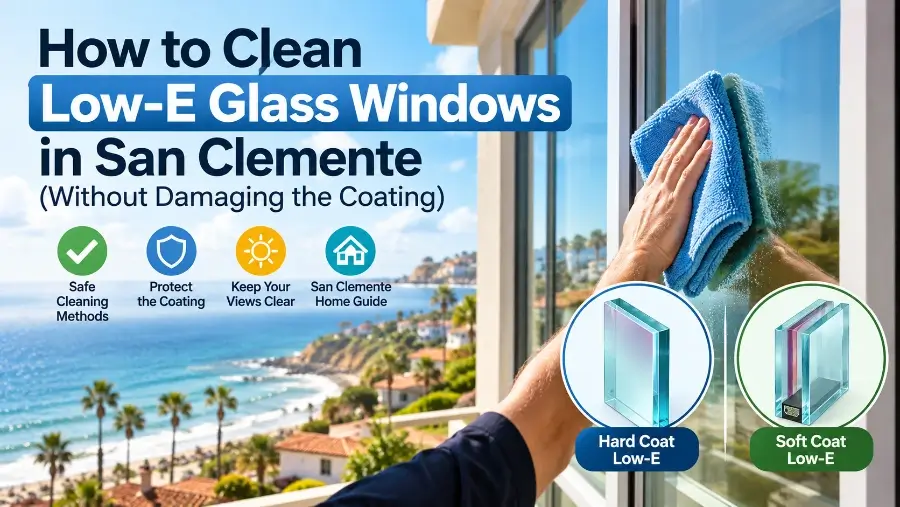
How to Clean Low-E Glass Windows in San Clemente (Without Damaging the Coating)
Low E Glass Window Cleaning In San Clemente
Low E glass has a microscopically thin metallic coating that blocks heat and UV rays. In San Clemente, virtually every home built after 2000 in Talega, Forster Ranch, Marblehead, and Sea Summit has it, required by California Title 24 energy code.
Cleaning Method: The safe cleaning method is plain water with a mild soap solution using a microfiber cloth, or a 1:10 white vinegar to water ratio for mineral film, per Pella SunDefense, Larson/AGC, and Modern Glass manufacturer guidelines.
What will damage the coating permanently: Ammonia based cleaners like Windex, razor blades, steel wool, abrasive pads, and pressure washers.
What Is Low-E Glass and Why Does San Clemente Have So Much of It?
Low-E stands for low emissivity. The coating is a microscopically thin layer of silver oxide or metal oxide on the glass surface. It does two things: reflects infrared heat back outside in summer and keeps heat inside in winter, and blocks up to 95% of UV rays, so floors, furniture, and rugs fade slower. In Southern California, that energy performance matters year round. San Clemente gets roughly 280 sunny days per year. Without Low-E glass, a west facing window in Sea Summit or Marblehead pushes interior temperatures noticeably higher on a Santa Ana day.
Here is the local reason to understand this: California’s Title 24 energy code required Low-E coatings in new residential construction starting in the early 2000s. Most homes built in Talega (92673), Forster Ranch (92673), Sea Summit, The Crest, and Signal Point in Marblehead (92672) after about 2000 very likely came with Low-E glass from the factory. Build year alone is not a guarantee; a quick flame test or your window manufacturer’s label will confirm it. Older homes in the Pier Bowl, Cyprus Shore, and the Ole Hanson area along Avenida Del Mar are more likely to have standard glass, but many have had windows replaced with Low-E units since.
What Low-E Glass Requires
Low-E glass comes with trade offs worth knowing. The coating requires ammonia free products and no abrasives, so standard cleaners like Windex gradually degrade it. Insulated units are more vulnerable to seal failure from thermal stress, and when a seal fails, the glass unit needs replacement rather than a cleaning fix. Certain window geometries can focus reflected sunlight into the yard. Knowing whether your coating is hard coat or soft coat changes the cleaning approach. None of these make Low-E glass impractical. They just mean it requires the right maintenance.
Low-E Glass Pros and Cons in San Clemente’s Coastal Environment
San Clemente’s coastal climate brings out both sides of Low-E glass. The UV protection is real. So are the maintenance limits. Understanding the trade offs helps you know what to watch for and when to call a professional.
Pros of Low-E Glass
- Helps reduce UV exposure: Some Low-E products block up to 95% of UV rays, helping slow fading of floors, rugs, and furniture. Performance varies by glass specification.
- Reduces unwanted heat gain: Solar-control Low-E glass can help limit heat entering through west-facing windows in sunny San Clemente.
- Maintains natural light: The right glass specification can help manage solar heat while keeping interiors bright.
- Supports energy efficiency: Properly specified Low-E windows can reduce heating and cooling energy use in Southern California.
- Common in modern homes: Low-E glazing is widely used in newer construction, including homes across Talega, Forster Ranch, and Marblehead. The actual glass type depends on the window specification.
Cons of Low-E Glass
- Needs suitable cleaning products: Some cleaners may be unsuitable for specific coatings, frames, or seals. Check the window manufacturer’s instructions before using Windex or other commercial products.
- Abrasive tools can cause damage: Razor blades, abrasive pads, and aggressive scrubbing may scratch or damage certain coated surfaces.
- Seal failure may require replacement: If an insulated glass unit develops fog or moisture between panes, cleaning cannot fix the internal problem. The unit may need repair or replacement.
- Coating type matters: Hard-coat and soft-coat Low-E glass differ in coating placement and durability. Homeowners may need manufacturer guidance to identify their glass.
- Reflected sunlight can be an issue: Certain glazing configurations may concentrate reflected sunlight on nearby materials. The risk depends on the window design and surroundings.
Cleaning tip: Start with clean water, a soft cloth, and a small amount of mild soap if permitted by the manufacturer. Avoid assuming that one cleaning method is safe for every Low-E product.
Hard Coat vs. Soft Coat Low-E: The Difference That Changes How You Clean
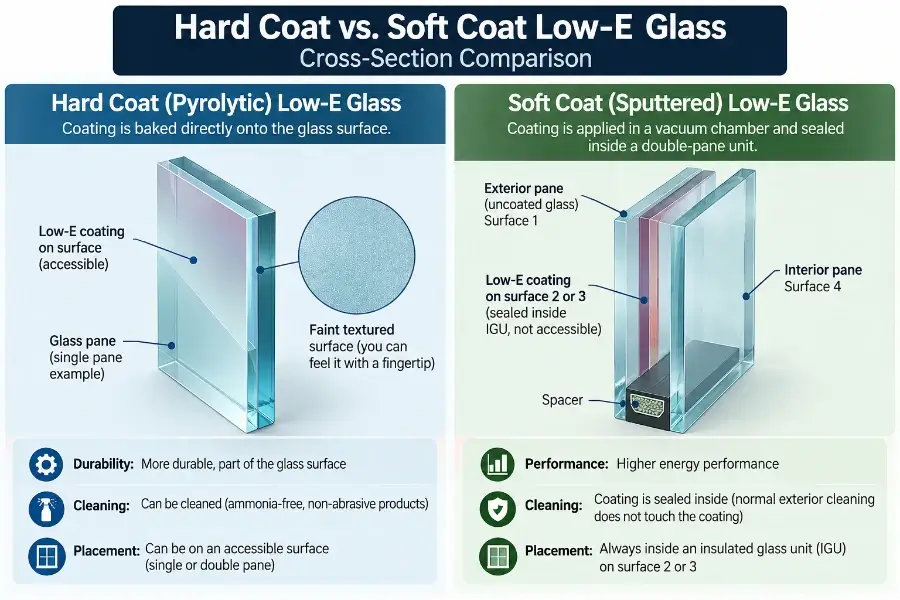
Not all Low-E glass is made the same, and that difference matters when it comes to cleaning. Some coatings may be exposed on an accessible glass surface, while others are sealed between panes inside an insulated glass unit. Knowing which type you have helps you avoid unsuitable cleaning products and tools. Here’s how to understand the difference before you start.
Hard Coat (Pyrolytic ) Low E
It is baked directly into the glass surface during manufacturing at extremely high temperatures. It is durable, can sit on an accessible surface, and has a faint texture you can feel with a fingertip. It is more resistant to normal cleaning, but still needs ammonia-free products and no razor blades or abrasives.
Soft Coat (Sputtered ) Low E
It is applied in a vacuum chamber after the glass is manufactured. It performs better thermally, but it is more delicate and must stay sealed. It is always installed inside an insulated glass unit (IGU) on surface 2 or surface 3, meaning it sits between the two panes of glass. Normal exterior cleaning never contacts the coating because it is sealed inside the unit.
The Practical Upside
On most modern double pane windows with soft-coat Low-E, exterior cleaning is not touching the coating at all. The outer face is standard uncoated glass. The risk is on hard coat surfaces that are accessible, and on aftermarket window film, which sits on an accessible surface.
Even though exterior cleaning does not touch a sealed soft-coat surface, using the wrong products can still degrade the rubber seals around the unit perimeter. In San Clemente, thermal stress from the marine layer combined with Santa Ana cycles puts mechanical pressure on seals already. If you are already seeing fog or condensation between panes, that is a different problem covered below.
How to Tell If Your Windows Have Low-E Glass
Before choosing a cleaner, it helps to know what kind of glass you’re dealing with. Low E coatings can be difficult to spot because they’re designed to remain nearly invisible during everyday use. A few simple checks may offer clues, but they cannot always confirm the exact coating type. Here’s what to look for and when to check with the window manufacturer.
The Frame Reflection Test
Hold a lit match or a phone flashlight a few inches from the glass and look at the reflections. Standard glass reflects each flame in the same color. Low-E glass reflects one flame in a different color, usually with an orange or pink tint, from the rest. That offset color is the coating.
The Etch Mark In the Corner
Many manufacturers etch a code in the corner of the glass unit. Pella marks SunDefense glass with an “E.” Andersen and Milgard use similar marks. Check the bottom corners first.
The Faint Tint Test
In direct shade, Low-E glass often has a slight blue or green cast. Hard coat glass has a faint uniform haze that is not dirt. If cleaning removes the haze, it was a contaminant. If the haze stays after thorough cleaning, it is the coating and it belongs there.
Still not sure? Call the original window manufacturer with your home’s build year and the window brand. Most can confirm by address and build date for homes built relatively recently.
Can You Use Windex on Low-E Glass?
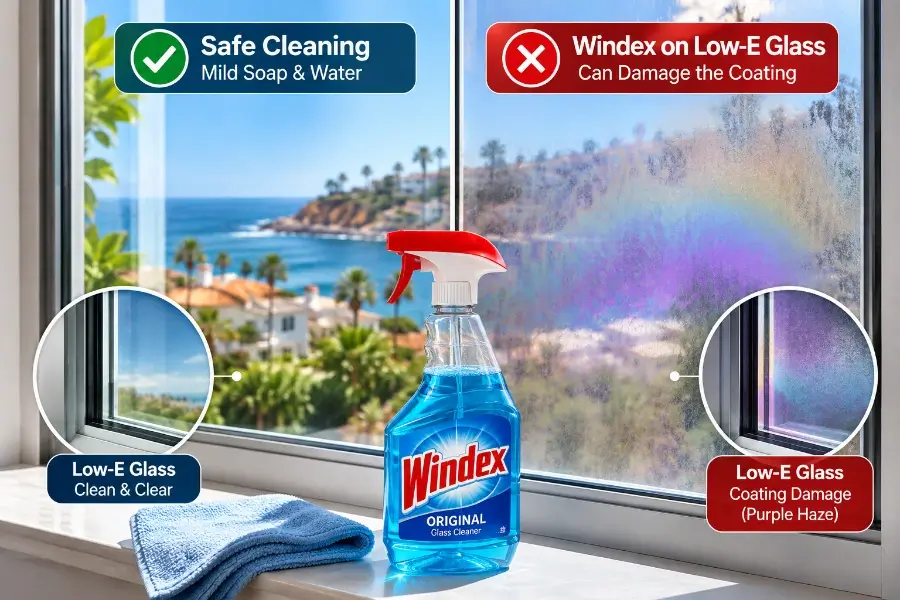
No. This is one of the most common questions we get, and the answer is a direct no.
Windex and most standard glass cleaners use ammonia as the active ingredient. Ammonia degrades metallic oxide coatings and can weaken rubber window seals with repeated contact. You may not see damage immediately, but over months of use ammonia gradually causes the coating to develop a purplish tint and can accelerate seal failure on double-pane units.
Per Pella SunDefense manufacturer guidelines, ammonia based and alcohol based cleaners are specifically prohibited on Low-E glass. Larson/AGC and Modern Glass manufacturer guides say the same.
The purple haze from ammonia exposure to Low-E and tinted glass is well-documented among professional window cleaners. It does not happen the day you clean, but it builds up. By the time you notice it, the damage is permanent.
Common Products To Clean Low E Glass Windows
You’ll find plenty of products claiming to leave glass spotless, but not every cleaner is suitable for every Low-E window. The right choice depends on the glass coating, window assembly, and manufacturer’s care instructions. Comparing common options can help you avoid guesswork and choose a sensible starting point for routine cleaning.
| Product | Safe for Low-E? | Why |
|---|---|---|
| Windex (classic blue) | Not recommended | Check the formula and glass manufacturer’s guidance before use; ammonia alone does not establish that a cleaner will damage Low-E coatings or seals. |
| Vinegar at 1:10 ratio | Check guidance | For mineral film; approved at this exact 1:10 ratio by Pella, Larson/AGC, and Modern Glass. Not for routine cleaning — soap and water is the default. |
| Dish soap + water | Generally preferred | A small amount of mild dish soap in water is a common starting point for routine glass cleaning. |
| Isopropyl alcohol | Spot use only | Use sparingly for suitable spots only when permitted by the manufacturer’s cleaning instructions. |
| Ammonia-free commercial cleaners | Check label | Choose a product explicitly approved for your coated glass and follow its directions. |
| Mr. Clean / Magic Eraser | Avoid unless approved | Abrasive melamine foam may scratch or damage certain glass surfaces and coatings. |
| Paper towels | Not ideal | May leave lint or streaks. A clean, soft microfiber cloth is generally preferable. |
| Full-strength vinegar | Avoid unless approved | Concentrated acid can affect some adjacent materials and finishes. Follow the glass manufacturer’s instructions. |
Which Cleaner Should You Start With?
When you’re unsure which product is safe, start simple rather than reaching for a strong glass cleaner. A mild soap and water solution with a soft cloth is a practical first option when permitted by the window manufacturer. Stubborn white marks may need a different approach, so it’s important to identify the residue before trying stronger solutions. Here’s how to choose your next step.
Routine Cleaning
For everyday dust, fingerprints and light dirt
Mild dish soap and clean water are a practical starting point for routine glass cleaning when permitted by your window manufacturer’s instructions.
Use a soft, clean microfiber cloth and rinse away residue. Avoid wiping dusty glass without rinsing first.
White Mineral Film
For white deposits from sprinklers or coastal exposure
White spots may be mineral deposits left by irrigation or evaporated water. Start by rinsing the glass and trying a gentle clean.
Diluted white vinegar may be suitable for some glass products, but do not assume a 1:10 solution is approved for every Low-E coating, frame or seal.
Heavy Mineral Buildup
For deposits that remain after gentle cleaning
Mineral deposits accumulated over several seasons may need a dedicated glass-restoration process rather than routine cleaning.
On coated glass, unsuitable compounds, abrasive pads or excessive pressure can cause damage. Identify the glass surface before attempting restoration.
Low-E glass reminder: Cleaning recommendations vary by manufacturer, coating type and window assembly. Check the product-specific care guide before using vinegar, commercial cleaners, abrasive tools or restoration compounds.
For daily maintenance the decision is simple: soap and water first, 1:10 vinegar when mineral deposits are visible. Everything else on the not safe list stays off Low-E glass.
The Right Way to Clean Low-E Glass: Step by Step Method
This process follows the consensus from Pella SunDefense, Larson/AGC, Modern Glass, and Guardian ClimaGuard manufacturer cleaning guidelines. For routine maintenance, mild dish soap and water is the default choice. Switch to a 1:10 white vinegar to water solution when you see mineral film or irrigation deposits, not as a general substitute for soap.
Remove the Window Screens First
Screens trap salt, dust, and debris. Cleaning glass with screens in place can allow trapped particles to transfer onto the glass and cause scratches during wiping.
Pro tip: Use the screen’s tabs or the appropriate removal tool rather than pulling or prying with your fingernails. Support the frame to avoid bending it.Rinse the Glass Before Wiping
Flush the glass thoroughly with clean water before using a cloth or sponge. Salt, sand, and loose debris can act as abrasives when dragged across the surface.
For coastal homes in Marblehead, Cyprus Cove, and Sea Pointe Estates, rinsing first is particularly useful when salt spray and windblown dust have accumulated.
Don’t skip this: Never dry-wipe dusty or salt-crusted glass.Apply a Suitable Cleaning Solution
For routine cleaning, use clean water with a small amount of mild dish soap. Apply enough solution to keep the glass lubricated while washing.
For mineral deposits, check the glass manufacturer’s instructions before using diluted white vinegar. Not every Low-E coating or window assembly permits acidic cleaners.
Low-E glass tip: Do not assume a vinegar dilution is universally approved. Follow the instructions for your specific glass.Wash with a Soft Microfiber Cloth
Use a clean, soft microfiber cloth or a non-abrasive sponge. Work from top to bottom with gentle, overlapping strokes, keeping the surface wet enough to reduce friction.
Avoid scouring pads, abrasive erasers, and aggressive scrubbing on stubborn spots.
Know when to stop: If a mark won’t lift with gentle cleaning, it may be mineral buildup or glass damage. Avoid pressing harder.Rinse Thoroughly with Clean Water
Rinse away all remaining soap and any cleaning solution that the manufacturer permits for your glass. Residue left behind can cause streaks and dull-looking patches.
For a cleaner finish: Use clean rinse water and avoid letting dirty runoff dry on the glass.Dry Gently with a Lint-Free Cloth
Use a clean, soft, lint-free microfiber cloth to remove excess water and reduce visible streaks. Follow the glass manufacturer’s specific drying instructions where provided.
Avoid aggressive dry-buffing, especially if the surface may still contain grit or residue.
Final check: Inspect the glass from different angles for streaks, leftover residue, or persistent mineral spots.Can A Squeegee Be Used To Clean Low E ?
Larson/AGC and Modern Glass state no squeegee should contact a coated surface directly. If you are cleaning the exterior of a double-pane unit where the coating is sealed inside, the squeegee contacts the uncoated outer face, which is fine. The issue is using a squeegee on an exposed hard coat surface.
What Professional Use To Clean Low E Glass Windows
Expert cleaners use a water fed carbon fiber pole with deionized water at under 5 TDS. San Clemente tap water runs 465-682 ppm TDS. Even with correct technique, that mineral load leaves calcium and magnesium deposits on the glass as it evaporates. Deionized water at under 5 TDS has nothing dissolved in it, so it leaves no residue.
4 Things To Never Use On Low E Windows
A cleaning shortcut can turn into an expensive mistake if it scratches the glass or damages a sensitive surface. Razor blades, abrasive pads, and aggressive cleaning methods can pose risks on certain coated glass products. Before tackling stubborn spots, know which tools to avoid and why the manufacturer’s instructions matter. These four precautions can help you clean more carefully. Low-E glass is the biggest reason DIY goes wrong on coastal homes.
Razor Blades
Larson/AGC states never to use any type of scraper on Low-E coated surfaces. A razor blade on hard-coat Low-E leaves micro-cuts that catch light as permanent haze. On soft-coat surfaces the blade can damage exposed edges.
Window cleaners sometimes use razor blades on plain glass for paint or stucco overspray removal during post-construction jobs. On coated glass, there is no scenario where a blade is the right tool.
Steel Wool
Steel wool leaves fine iron particles embedded in the glass surface. Those particles oxidize and create rust-colored spots. On Low-E glass, steel wool also turns the coating purplish, the same effect as ammonia.
A professional window cleaner described this:
That is not recoverable.
Abrasive Pads
White pads are sometimes acceptable on standard glass and window film, but not on Low-E coated surfaces. Scouring pads are never acceptable.
Pressure Washer
Pressure drives hard mineral particles into the glass surface at high speed. San Clemente’s tap water at 465-682 ppm TDS is loaded with calcium and magnesium crystals. Running that through a pressure washer at the glass concentrates the mineral impact and can compromise window seals.
Modern Glass manufacturer guidelines specifically prohibit pressure washing on Low-E glass.
Low-E Glass and San Clemente Hard Water: A Two-Part Problem
In San Clemente, window cleaning can mean dealing with more than everyday dust. Sprinkler overspray may leave white mineral spots, while coastal exposure can add salt and debris to the glass. When deposits build up, repeated scrubbing may do more harm than good, especially if you’re unsure which surface you’re cleaning. Understanding the difference between ordinary dirt and mineral buildup helps you choose a safer approach.
Why San Clemente Tap Water Leaves Mineral Film on Glass
San Clemente tap water runs 465-682 ppm TDS and 236-293 mg/L hardness, well above the USGS very hard threshold of 180 mg/L (City of San Clemente 2025 Water Quality Report). When that water evaporates on glass, calcium and magnesium stay behind as white film.
On standard glass, a restoration compound removes it. On Low-E glass, the process requires lighter pressure and glass safe compounds kept wet throughout, no diamond pads at full pressure, no razor blades, no acid treatments.
Irrigation Calcium in Forster Ranch and Talega
In Forster Ranch and Talega (92673), HOA irrigation sprinklers hit ground floor windows every watering cycle. Same municipal water, same TDS range. It builds as a white band at the base of ground floor glass. On Low-E surfaces this needs professional treatment, DIY scrubbing risks the coating.
Fog Between Panes: Seal Failure vs. Dirty Glass
If you see condensation, fogging, or a milky film trapped between the two panes of a window, no amount of cleaning will fix it. That is seal failure on the insulated glass unit (IGU), and it is a different problem entirely.
What Causes IGU Seal Failure on the Coast
Double pane windows have a hermetically sealed air or argon gas space between the panes. The Low-E coating on most modern windows sits inside that space. When the rubber seal around the perimeter degrades, outside air carrying moisture gets in. That moisture condenses inside the unit and shows as fog, water droplets, or a hazy film you cannot reach from outside.
Coastal thermal stress accelerates seal failure in San Clemente. The marine layer, which peaks from May through August, swings daily temperature and humidity at the glass surface. Add Santa Ana winds bringing hot dry air from the interior, and you have repeated thermal cycles stressing the seal faster than in a stable inland climate.
When You Need Replacement, Not Cleaning
Our cleaners assess windows before quoting. When we find a fogged IGU, we tell the homeowner directly, the glass unit needs replacement, and cleaning will not help. Typical IGU replacement in Orange County runs $300-800 per unit depending on size and Low-E specification.
If you see fog between panes in Marblehead, Sea Summit, or anywhere along the 92672 coast where salt and thermal stress are highest, call for an assessment before booking a standard clean. We can tell you what you actually need.
The Magnifying Glass Effect: A Note on Low-E Windows and Reflected Heat
Some double-pane Low-E window configurations can reflect concentrated sunlight onto a nearby spot in the yard, particularly with slightly curved glass or certain frame profiles. This is a physics issue, not a cleaning problem.
Andersen Windows and other manufacturers acknowledge it in their product care documentation. If you notice scorched artificial grass, warped vinyl trim, or a dead patch in a garden bed near a window, contact a window specialist. The typical fix is window film or external shading on the affected unit, not a glass replacement.

Does Cleaning Low-E Glass the Wrong Way Void Your Window Warranty?
Concerned that the wrong cleaner could affect your window warranty? The answer depends on the specific manufacturer, product, and warranty terms, not a single rule that applies to every Low-E window. Some care guides restrict particular cleaners or tools, so it’s worth checking before you begin. Here’s what to review and what to ask before hiring a window cleaner.
What Manufacturers Prohibit
Most window manufacturers, including Andersen, Pella, Milgard, and Marvin, specify pH neutral cleaning products only and explicitly prohibit ammonia, abrasives, and pressure washing. Using an unapproved cleaner may affect a warranty claim if damage occurs, warranty terms vary by manufacturer and product.
Builder Warranty and Move In Cleaning
If you move into a Talega or Forster Ranch home with windows still under the builder warranty, using Windex to clean up move in debris can void that warranty before the ink is dry. The same applies if you hire a window cleaner who uses a standard ammonia based solution, if the coating later shows damage, the warranty claim gets complicated because a prohibited product was used.
What to Ask Before You Hire a Window Cleaner
Check your window warranty documents for the prohibited products list. When hiring a window cleaner, ask directly: What solution do you use on Low-E coated glass? If they cannot answer without hesitation, that is a signal worth noticing.
New Window Film and the 30-Day Rule
If you have had window film applied recently, wait at least 30 days before professional cleaning. New film needs time to fully cure and bond to the glass. Cleaning during the cure window can lift the film at the edges and introduce water under it.
When you call to book with us, mention if you have had new film applied in the past 30 days. We adjust our technique on filmed glass: softer pressure, no squeegee at the edges, and specific cleaning agents the film manufacturer approves.
Questions to Ask Any Window Cleaner Before They Touch Your Low-E Glass
Use these questions when you are comparison shopping in Low E glass window cleaning in San Clemente.
Do you use ammonia-free products on coated glass?
The correct answer is yes. If they say “we use a standard commercial cleaner,” ask them to name it so you can check the label.
Do you test your water TDS before cleaning?
Our cleaners measure deionized water with a TDS meter before every job. We target under 5 TDS. A cleaner who does not check TDS is likely using tap water, which in San Clemente runs 465-682 ppm.
Do you use razor blades on glass?
The correct answer on coated glass is no. On standard plain glass, a razor blade can be a legitimate tool for paint or sticker removal, but it has no place on a Low-E surface.
Are you insured and can you provide a COI?
We carry general liability insurance and can provide certificates of insurance to HOA management companies in Talega, Forster Ranch, and gated communities including Sea Pointe Estates on request.
How do you handle guard-gated communities?
If you are in Sea Pointe Estates (92672) or another guard-gated neighborhood, your cleaner needs to know the process for gate access and vendor coordination. We handle this regularly throughout San Clemente.
How Often Should Low E Windows Be Cleaned in San Clemente?
The right schedule depends on where your home sits relative to the ocean. The intervals below are recommended starting points based on typical service experience in each zone. Your actual windows may need adjustment depending on exposure, tree coverage, and irrigation.
Ocean Facing Homes
Every 6–8 weeksThese homes face the salt air directly. Salt is hygroscopic, meaning it attracts and holds moisture, and it spreads across the glass as a film. On Low-E glass, that salt film absorbs heat differently and dulls the coating’s reflective performance. A 6-week schedule keeps salt load manageable.
Near Coast Homes
Every 8–10 weeksSalt levels are somewhat lower, but marine layer deposits from May through August still create mineral film. The marine layer carries dissolved minerals that cement onto the glass when it burns off in the afternoon.
Inland Neighborhoods
Every 10–12 weeksLower salt exposure, but irrigation calcium from HOA landscaping systems is a consistent issue on ground-floor windows. Talega HOA conducts spring and fall visual inspections, and dirty windows can generate compliance notices.
After Santa Ana Wind Events
Within 3–5 daysSanta Ana winds carry silica dust, debris, and fine particles that embed in mineral deposits on the glass. The marine layer that typically follows a Santa Ana will cement that debris into the surface if you wait longer. This applies to all Low-E glass in all San Clemente neighborhoods.
Is Low-E Glass Windows Hard to Clean?
Not if you use the right method. The coating is sealed inside the glass unit in most modern double pane windows, so exterior cleaning does not even contact it. The exterior face is standard glass.
Where Low-E glass becomes harder to clean is when the wrong products have already been used. Ammonia residue, steel wool marks, and razor scratches cannot be removed. They are permanent. A window maintained correctly for 10 years with ammonia free products and no abrasives is simple to clean. A window that has had Windex applied for years and been scraped with a blade may need a coating assessment before you decide whether cleaning or replacement makes more sense.
What Does Low-E Glass Window Cleaning Cost in San Clemente?
As a rough estimate only, confirmed before any work begins. See our window cleaning cost guide for San Clemente for the full pricing breakdown. If you are looking for Low-E window purchase or IGU replacement pricing, that is a separate cost from cleaning. When seals fail, IGU replacement in Orange County typically runs $300-800 per unit depending on size and specification.
Single Story Exterior
Final price depends on window count, accessibility, and current condition. Heavy mineral buildup requires more time.
Two Story Exterior
Our water-fed carbon-fiber pole eliminates the need for ladders on clay-tile roofs or patio covers, which reduces risk and speeds the job.
Hard Water Mineral Restoration
Job-level pricing depends on severity. This is separate from standard cleaning and involves a different technique.
Is professional cleaning worth it?
For most San Clemente homeowners with coastal salt exposure and hard water, yes. Tap water at 465-682 ppm TDS leaves mineral deposits even with the right technique. A professional using deionized water under 5 TDS leaves no residue by definition, which reduces the frequency of deep mineral treatments and extends the time between restoration jobs. For homes in the 6-8 week salt zones like Cyprus Shore or Sea Pointe Estates, the long-term cost of skipping professional cleaning shows up as mineral restoration work that costs more than the cleans you skipped.
DIY vs. Professional for Low-E glass Windows
For light routine maintenance with no mineral buildup, DIY with microfiber cloths, mild soap, and distilled water works fine on accessible ground floor windows.
Where it stops making sense: second story windows requiring a ladder, significant hard water mineral deposits, post-construction residue, or any situation where the wrong product was used previously. The cost of one window replacement runs far above the cost of a professional clean, so when there is any doubt about product safety or technique on coated glass, calling first makes more financial sense.
Frequently Asked Questions On Low E Glass Window Cleaning
Your San Clemente Low E Windows Deserves Care
Call Pane & Surface Care to get an estimate for Low-E safe window cleaning in San Clemente. We quote before any work begins.