
Deionized Water Window Cleaning in San Clemente: What It Is and Why It Matters on the Coast
Standard tap water cleans your glass and then leaves its own mineral deposit when it dries. On the California coast, where tap water is very hard and salt air compounds on top of it, that mineral residue is what you see as streaks and haze. Deionized (RO/DI) water has very low dissolved solids. When properly purified, it leaves very little mineral residue as it dries.
San Clemente Focused 92673- 92672- 92674
Licensed & Insured in California
Background-Checked Technicians
Filtered De-Ionized Water System
Water-fed carbon-fibre pole
Did You Know
Deionized (RO/DI) window cleaning uses water that has been purified to near-zero dissolved solids, typically under 5 parts per million TDS, measured before each use. When that water contacts your glass, the brush agitates surface contamination while the purified water rinses away loosened dirt, salt and other residues. When properly purified, it leaves very little mineral residue as it dries. Much less mineral residue, spotting, and streaking from the rinse water.
For San Clemente homes, where local tap water runs at 465 to 682 ppm and the marine layer adds salt on top of that every morning, For exterior glass in San Clemente’s hard-water coastal environment, purified RO/DI water greatly reduces the mineral residue that ordinary tap water can leave behind.
Why Tap Water Leaves Streaks on San Clemente Glass
Water is never just water. Every municipal supply carries dissolved calcium, magnesium, sodium, and other minerals, invisible in the water itself but left behind as white spots, streaks, or a hazy film once it evaporates on glass.
Water service in San Clemente isn’t uniform citywide. Most of the city is served by the City of San Clemente, Talega by Santa Margarita Water District, and parts of southern San Clemente by South Coast Water District. The City of San Clemente’s 2025 report includes TDS readings in the 465–682 ppm range across reported distribution zones, with hardness at 236–293 mg/L. If you’re served by SMWD or SCWD, your provider’s own report will show the figures for your service area. Southern California water runs hard to very hard across the board, which is why RO/DI is the standard approach here regardless of which system supplies your street.
Clean your windows with that water and let it dry, and you’re adding a mineral deposit in the process of cleaning it. The cleaner your glass was before the clean, the more visible the residue becomes, because there’s nothing else on the glass to compete with it.
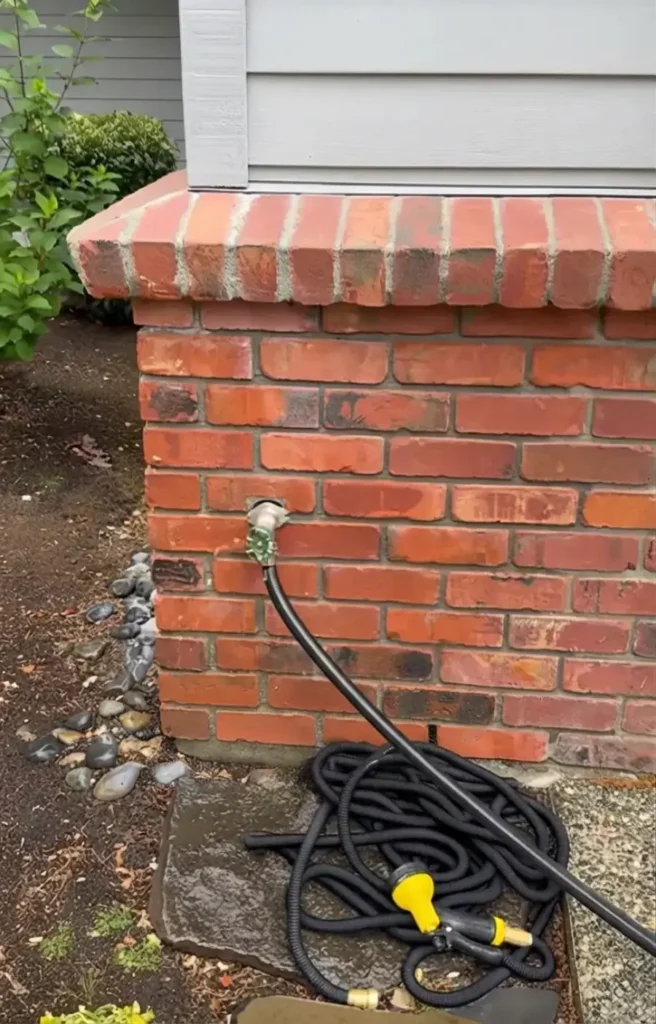
COMPARISON TABLE: San Clemente tap water vs RO/DI water
The water you clean with matters as much as the tools you use. San Clemente tap water carries dissolved minerals that can remain on glass as it dries, while RO/DI water brings that mineral load down dramatically. Here is the side-by-side difference.
| Measurement | San Clemente Tap Water | RO/DI Water (Our Method) |
|---|---|---|
| Total Dissolved Solids (TDS) | 465–682 ppm (City 2025 report) | Under 5 ppm (measured per visit) |
| Hardness (CaCO₃) | 236–293 mg/L (Very hard per USGS) | Near zero |
| What Happens When It Dries on Glass | Mineral residue can remain as spots, streaks, or haze | Very little mineral residue is left behind |
| Result After Cleaning | Clean glass may develop new mineral residue as water dries | Clean glass with much less mineral residue from the rinse water |
How Deionized Water Is Made and How It Cleans
RO/DI is not one process, it’s two. Reverse osmosis (RO) is the first stage, a membrane that filters out most dissolved solids. Deionisation (DI) is the second stage, a resin polish that removes what the membrane didn’t catch. Together, RO and DI produce water clean enough to rinse glass without leaving anything behind.
Deionisation
Deionisation (DI) passes the RO-filtered water through ion-exchange resin. The resin captures the remaining dissolved ions by exchanging them for hydrogen and hydroxide ions, which combine to form pure water. The output is water typically under 5 ppm TDS, providing very low-mineral water for the final rinse.
Reverse Osmosis
Reverse Osmosis (RO) forces tap water through a semi-permeable membrane under pressure. The membrane allows water molecules through but blocks dissolved salts, calcium, magnesium, and most other solids. The output is water at a small fraction of the original TDS typically 90 to 95 percent of dissolved solids removed. The output has a much lower TDS than the original tap water, with the exact reduction depending on the RO system and water conditions.
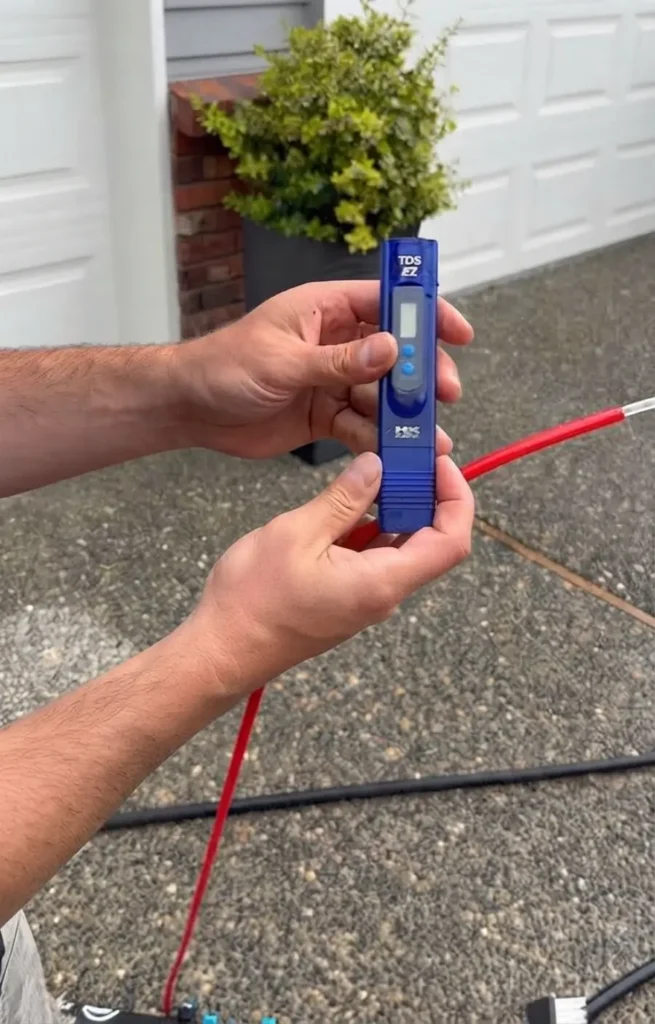
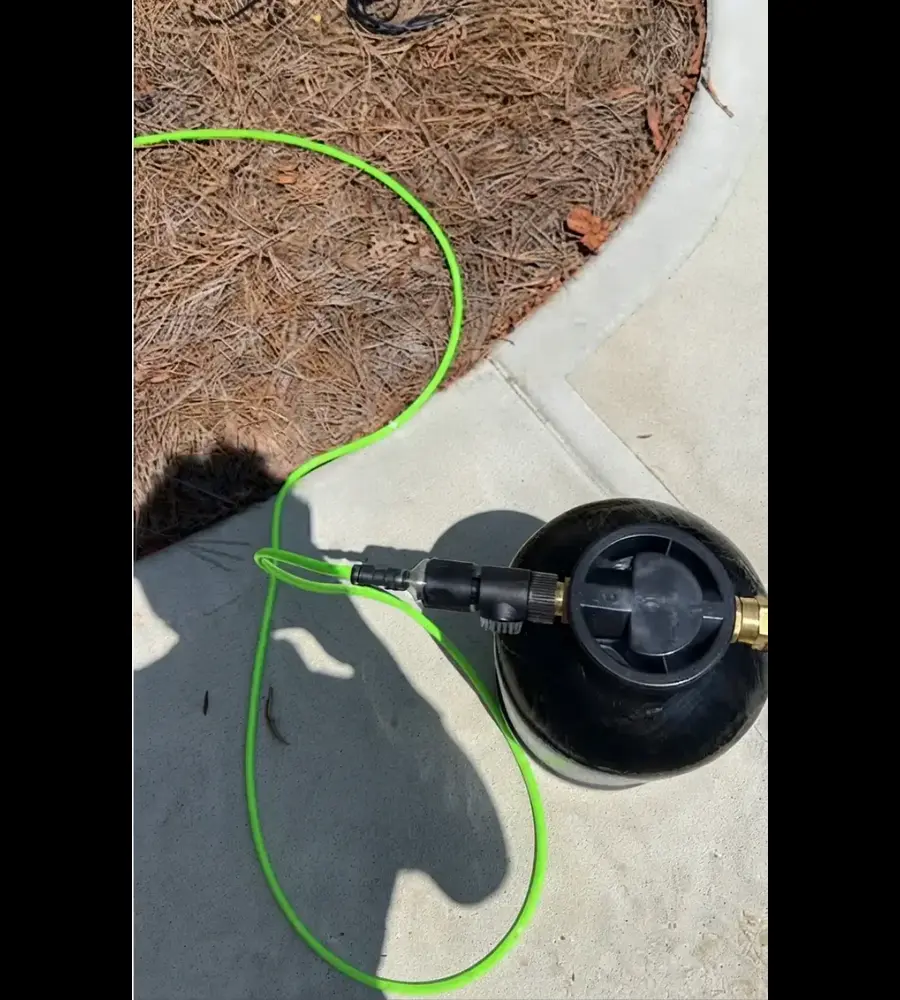
This deionized water is produced on-site in the cleaning van, measured with a TDS meter before every visit, and delivered to the glass surface through a water-fed pole with a brush head. Our cleaners verify the reading is under 5 ppm before starting work.
RO vs DI: What’s the Difference?
RO reduces most dissolved solids through a membrane. DI resin then removes remaining ions. In professional window cleaning, combining RO and DI allows the system to produce very low-TDS water continuously from the van rather than relying on store-bought distilled water.
Does RO/DI Replace a Squeegee?
This distinction matters because DI water only helps when it stays pure through the whole process. DI water is most useful when it stays uncontaminated through the cleaning process. Once it is transferred into a dirty bucket, rag, or sponge, the process can reintroduce contaminants, which is why RO/DI is particularly well suited to continuous water-fed pole cleaning.
For Exterior Glass
Yes, largely. A water-fed pole delivers RO/DI water continuously, and because the water carries no dissolved solids, it can be left to air-dry instead of being squeegeed off. That’s the whole point of the method: the water leaves nothing behind, so there’s nothing to wipe.
For Interior Glass
No for interior glass. Running purified water through a pole indoors isn’t practical, so interior windows are still cleaned with a traditional applicator, cleaning solution, and squeegee. RO/DI and traditional cleaning aren’t competing methods, they’re used for different sides of the same window.
The Water-Fed Carbon-Fibre Pole — What It Does
Clean glass is one thing and reaching it safely is another. A water-fed carbon-fibre pole lets the technician clean upper-level exterior glass from the ground while purified water flows through the pole to the brush.
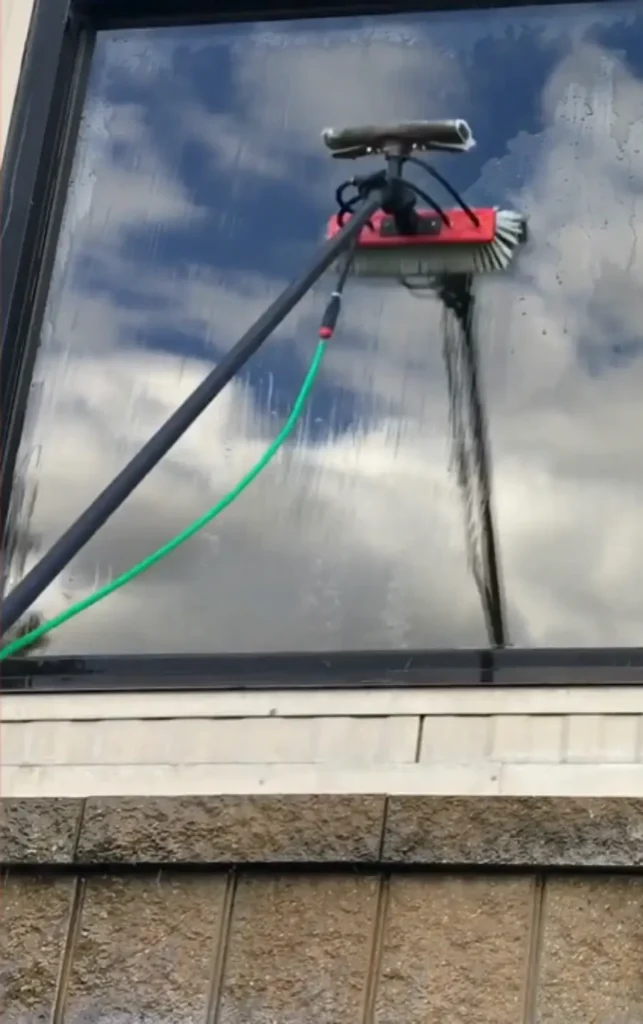
The deionized water is delivered through a water-fed carbon-fibre pole a telescoping pole that extends to reach second and third-floor glass from ground level, with a brush head at the end and pure water flowing through the pole itself.
The brush head agitates the glass surface, loosening mineral deposits, salt film, and organic contamination. The flowing RO/DI water rinses the loosened contamination off continuously. The glass is left wet with pure water, which then dries without leaving any residue.
This means upper-floor glass is cleaned without ladders on patio covers, clay-tile roofs, or finished landscaping. It also means the brush-and-flow method can clean the glass, frame perimeter, and sill in one continuous process.

How RO/DI Water-Fed Pole Cleaning Works
It is not just purified water sprayed onto the window. The process combines low-TDS water, controlled brush agitation, continuous rinsing, and natural drying to remove surface contamination without adding the mineral residue found in ordinary tap water.
For upper-floor San Clemente homes, this also means cleaning from ground level, without ladders on patio covers, clay-tile roofs, or finished landscaping.

Why San Clemente Needs Purified Water More Than Inland Areas
Inland cities with softer water where TDS runs at 100 to 200 ppm rather than 465 to 682 ppm can get acceptable results from a skilled squeegee operator using tap water, because the residue is minimal. In San Clemente, the math does not work the same way.
Three things compound on coastal glass here that do not compound the same way inland:
Salt aerosol from the Pacific.
The marine layer carries dissolved sodium chloride and deposits it on every exterior surface daily. Salt is hygroscopic and it attracts moisture, spreads into a film, and bonds to the glass surface over repeated wet-dry cycles. Our salt air damage guide covers the full mechanism.
Hard local tap water.
At 465 to 682 ppm, any irrigation overspray, hose rinse, or cleaning pass using local water adds to the mineral load on the glass. This is the primary cause of the white calcium staining common on lower-third glass panels in Talega, Forster Ranch, and the inland HOA communities where sprinklers are active.
June Gloom marine layer.
From late May through early July, the marine layer repeatedly deposits moisture and coastal residue on exterior glass, moisture deposits every morning, sun evaporates it every afternoon, minerals accumulate without interruption for six weeks. Adding a tap-water clean to that cycle can add another source of mineral residue to the glass.Read More on June Gloom.
RO/DI water does not stop San Clemente’s coastal exposure. It removes one part of the cycle by keeping the cleaning water from adding the mineral residue associated with ordinary tap water.
Where We Use RO/DI Water in San Clemente
Not every San Clemente property has the same glass, height, or access challenges. From two-story homes to storefronts, HOA communities, and vacation rentals, RO and deionized water window cleaning works particularly well for exterior glass where reaching the upper panes can be difficult.
Residential homes — exterior glass on single and two-story properties, our standard method.
Commercial and storefronts — RO/DI rinsing works the same way at scale, without chemical runoff near foot traffic. See commercial window cleaning.
HOA and multi-story communities — the water-fed pole reaches upper floors without ladders on shared landscaping or common areas. See HOA window cleaning.
Vacation rentals — a fast, chemical-free turnaround between guests, with no residue on glass or sills.
What TDS Means for Your Windows
TDS (total dissolved solids) measures how many minerals are in the water, in parts per million. The lower the number, the less residue the water leaves behind when it dries. Our operating target is under 5 ppm before the water reaches your glass. We check it with a TDS meter before starting work, not as a one-time system spec, but every visit.
| TDS Reading | What It Means |
|---|---|
| 0-5 ppm | Very low dissolved solids, our operating target for every visit |
| 5-10 ppm | Still low, but worth monitoring on a filtration system |
| 10+ ppm | Filtration resin typically needs attention before relying on spot-free drying |
| 465-682 ppm | San Clemente tap water range (City of San Clemente 2025 report) |
When DI Water Won’t Fix the Glass
RO/DI water solves one specific problem that it stops the cleaning process itself from adding mineral residue. It does not undo damage that happened before we arrived. Four situations where pure water alone will not get you a clear result. A cleaner will tell you honestly which of these you’re dealing with, before charging for a standard clean that won’t fix it.
If calcium or silica has been building up for months and has already bonded to the glass, a standard RO/DI clean will not lift it. That glass needs a restoration treatment first. See our hard water stain removal services for what that involves.
If the glass surface has been chemically altered by long-term mineral exposure, the etching is permanent. Changing the water used to clean it will not restore the original surface.
If the haze sits between the two panes of a double-pane window rather than on the surface, no amount of exterior cleaning reaches it. That is a broken seal, and it needs repair or replacement, not a cleaning.
Pure water can leave the glass itself spotless while a dirty screen or debris-filled track continues contributing dirt back onto the pane. If your windows look dirty again unusually fast, the screen is worth checking. See our window screen cleaning.
Does RO/DI Cleaning Cost More?
Professional RO/DI water-fed pole cleaning is now the standard method for coastal residential window cleaning, not a premium add-on. On our visits it is the standard method, not an upgrade. The equipment cost is on the professional’s side, not yours.
What changes with RO/DI cleaning is not the price per visit but the interval between visits. Glass cleaned with purified water stays cleaner noticeably longer than glass cleaned with tap water, because the clean does not leave a mineral base layer for the next round of salt and dust to bond to. For San Clemente, How long the result lasts depends on coastal exposure, irrigation overspray, weather, window condition, and cleaning frequency.
Purified-water cleaning removes the mineral contribution from the cleaning water itself, but it does not stop new salt, dust or irrigation residue from reaching the glass afterward two to three weeks longer than a tap-water clean would.
You can see current pricing estimates on our San Clemente window cleaning cost guide
Tap Water vs Deionised Water for Window Cleaning
Tap water isn’t bad water, it’s just not built for glass. The same minerals that make it safe to drink are what stay behind on a window once the water evaporates. RO/DI water is tap water with those minerals filtered out specifically so nothing is left to dry into a spot.
| San Clemente Tap Water | Deionised (RO/DI) Water | |
|---|---|---|
| Total dissolved solids | 465–682 ppm (City of San Clemente 2025 Water Quality Report) | Under 5 ppm, checked before every visit |
| Hardness | 236–293 mg/L as calcium carbonate, “very hard” per USGS | Near zero |
| What happens when it dries | Minerals can remain as spots, streaks, or haze | Very little residue is left behind |
| Cost to use | Free from the tap | Requires on-site filtration equipment |
| Best for | Drinking, irrigation, household use | Rinsing exterior glass without adding mineral load |
Distilled vs Deionized Water Window Cleaning
Both are low-mineral water, but they are made differently and used differently in practice. For a single window or a small DIY job, distilled water from the store works fine. For exterior residential or commercial cleaning where a water-fed pole runs continuously, RO/DI is the practical choice because it’s produced on-site in the volume needed and checked with a TDS meter
| Measurement | Distilled Water | Deionized (RO/DI) Water |
|---|---|---|
| How it’s made | Boiling and condensation | Reverse osmosis membrane + ion-exchange resin |
| Mineral content | Very low | Very low, typically under 5-10 ppm |
| Small DIY jobs | Suitable | Suitable |
| Water-fed pole cleaning | Not practical at volume | Standard method |
| On-site production | Not typical | Yes, produced continuously through the van’s system |
Got Questions?
Everything San Clemente residents want to know about deionized water window cleaning – answered directly.
Call us (949)-882-1434
Deionized Purified Water — What Coastal Glass Actually Needs
Call and we will send a local cleaner with a water-fed carbon-fibre pole and RO/DI water verified under 5 ppm. No streaks when it dries. From the Pier Bowl to Talega, 92672, 92673 & 92674 San Clemente.